

By Charles Lonardo
OpenEvidence is quickly emerging as one of the most widely discussed AI tools in healthcare today. Not because it promises to replace physicians, but because it changes how they access and apply medical evidence in real time.
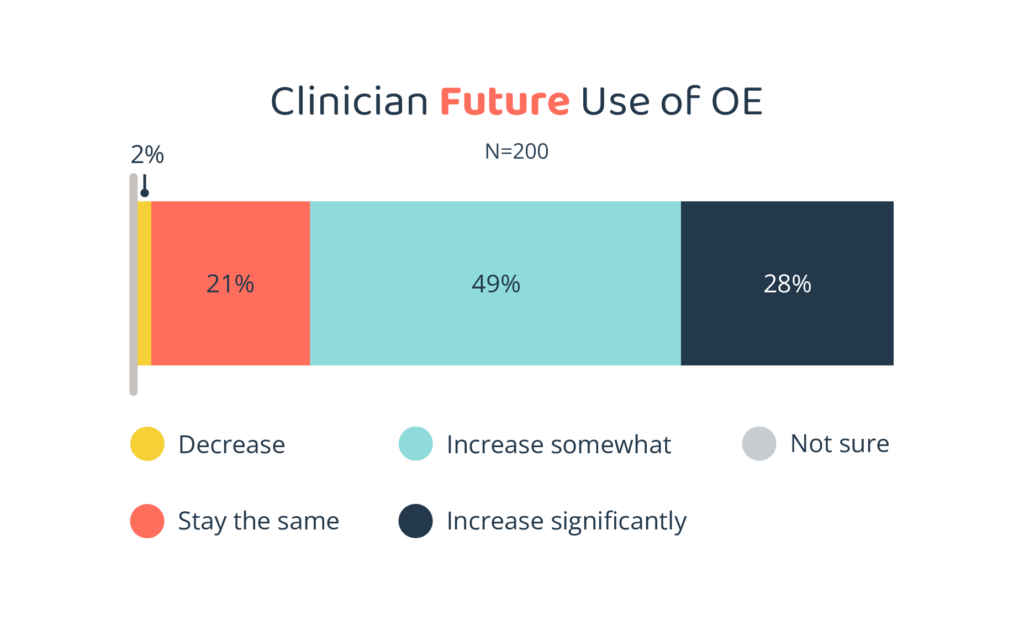
In a recent Konovo study of 200 physicians and medical residents, nearly half of HCPs said they already use OpenEvidence either regularly or occasionally, while another 49% expect their usage to increase in the future. For a category where most new technologies struggle to integrate into daily practice, that level of momentum is notable.
But the more revealing insight is how clinicians are using it.
The dominant use cases were not primarily administrative, though administrative support remains part of the picture. Physicians reported turning to OpenEvidence for clinical questions, literature reviews, and complex decision-making, particularly in situations where guidelines are unclear or multiple treatment options seem reasonable. One respondent described using the platform to “filter through a ton of low-quality research to find the signal from the noise.”
In many ways, that captures the broader challenge in delivering high-quality healthcare: information is abundant, but synthesis is scarce. Accessible synthesis is even scarcer.
What emerged from the data was a picture of AI not as a replacement for clinical judgment, but as a tool increasingly embedded at the point of care and within clinical reasoning itself.
Still, trust remains conditional.
Clinicians value the speed and accessibility of AI-powered evidence retrieval, but concerns around hallucinations, source data, inconsistent outputs, and workflow integration remain persistent. The technology has crossed from novelty into utility, but not yet into infrastructure. If these tools can be integrated more seamlessly into clinical workflows, adoption is likely to continue growing.
That distinction matters. When clinicians stop asking whether a tool is useful and start asking why it is not integrated directly into the EHR, expectations have fundamentally changed. In fact, 65% of clinicians said better EHR integration would increase their usage of OpenEvidence.
The full report explores where AI tools like OpenEvidence are already reshaping clinical workflows and what still needs to happen before adoption becomes routine rather than episodic. Get the complete Market Signals report today.